Torque Burnout
- 4.1
- Rating
- 10.00M
- Installs
- Free
- Price
 Analysis by App-foxy
I approached Torque Burnout as a decision rather than simply another racing download. Its appeal is easy to understand: instead of asking me to complete a long championship or memorize a large map, it puts the focus on pushing a car hard and making each run feel dramatic. That makes it a very different proposition from a conventional circuit racer. I can pick it up for a short session, work on controlling a slide, and chase the satisfaction of a cleaner, more committed run.
Developed by Hooned Games, this free racing game has been available since December 30, 2015. It has built a substantial audience, with more than 10 million installs, a 4.1 average from roughly 284 thousand ratings, and about 7.4 thousand written reviews. Those figures suggest a game with staying power, but they do not automatically make it right for everyone. My experience is that its strongest qualities appear when I want focused driving practice and spectacle, while its limitations become clearer if I expect a full simulation, a broad open world, or a quiet experience without purchase prompts.
What to consider before choosing it
The first question is what kind of racing mood I want. If I am looking for a traditional race against a field of opponents, with overtaking and position changes as the main source of tension, this is not the most obvious fit. The central pleasure here is more personal: I am trying to keep the car balanced, build confidence, and turn a controlled loss of traction into something that looks and feels deliberate.
You May Also Like

 Blood Strike: 2.5 Anniversary
Blood Strike’s Loadouts Turn Every Drop Into a Tactical Gamble
A close look at Blood Strike’s custom loadouts: how fast access to signature weapons reshapes its battle royale rhythm, rewards preparation, and narrows the gap between fights.

 Pandora - Music & Podcasts
Pandora’s Music Is Easy to Start, but Harder to Recover
Pandora’s strength is its low-effort path from a seed to a station. Its weak spot is how much confidence it asks you to place in connection, setup, and quiet recovery.

 8 Ball Pool
 Is Built on Rivalries, Rematches, and Routine
A close look at the rivalries, rematches, shared routines, and unanswered safety questions that turn a quick pool match into a persistent mobile community.

 Samsung Music
’s Quiet Strength Is Playing What You Already Own
Its reach comes less from spectacle than from dependable access to a personal library. That simplicity is both the app’s strongest retention engine and its ceiling.

 AccuWeather: Weather Radar
AccuWeather Review: A Quick, Clear Forecast for Everyday Decisions
For everyday plans, the best forecast is the one you can understand quickly. AccuWeather makes rain timing, radar, and local conditions easy to act on, with a few trade-offs.

 Hill Climb Racing
Why Hill Climb Racing Still Turns Crashes Into One More Run
A tiny car, a bumpy hill and one more upgrade: Hill Climb Racing keeps resurfacing because its simple chaos makes every near-miss feel personal.
More From Our News Desk



That distinction matters because the game can seem simple at first. The basic goal is immediately readable, but getting a run that feels smooth rather than messy requires attention. I have to think about steering input, throttle timing, and how aggressively to continue once the car starts moving sideways. In other words, it rewards repeatable control rather than random aggression. Holding the throttle down may create noise and movement, but it does not automatically create a satisfying result.
I also see it as a good choice for people who enjoy short, self-directed sessions. A typical everyday use case would be opening the game during a commute break or while waiting for an appointment, completing a few attempts, and closing it without feeling obliged to follow a long narrative. It is less suitable for someone who wants a deep career structure that steadily introduces new race types and opponents over a long evening.
The age rating is Everyone, which makes the presentation broadly approachable. Still, the word “Everyone” should not be confused with “effortless.” Younger players may understand the visual goal quickly, but consistent control can take patience. For adults, that learning curve is part of the attraction; for someone who wants instant wins, it can become the main source of frustration.
How the driving feels in practice
My best advice is to treat each attempt as a small experiment. Rather than immediately trying to create the biggest possible slide, I first aim for a stable line and notice what happens when I make a smaller steering correction. Once I understand how the car reacts, I can add more throttle or angle without turning every run into a recovery attempt. This approach is more useful than simply repeating the same dramatic input and hoping the result improves.
That also reveals one of the game’s less obvious strengths: it gives me a reason to pay attention to transitions. The beginning of a slide is only one part of the challenge. The more interesting moment comes when I need to keep the car moving in the intended direction while preventing the rear from escaping too far. Players who enjoy refining timing will find more depth here than the straightforward presentation initially suggests.
There is a trade-off, though. The same focused design can feel narrow if I need constant novelty. A conventional arcade racer may offer more variety through different tracks, race formats, and opponents. Here, the satisfaction depends heavily on whether I enjoy improving a specific driving skill. If I do, repetition becomes practice. If I do not, repetition may feel like a lack of content.
Why the focused format works
The game wins against many ordinary mobile racers by making the driving itself the event. I do not need to wait for a long race to reach an exciting moment. A single well-managed sequence can provide the payoff. That is especially useful on a phone, where I may have only a few minutes and do not want to commit to a complete competition.
It also has a stronger sense of personality than a generic traffic racer. The emphasis on pushing a ride beyond normal road behavior gives every successful attempt a clear identity. I am not merely trying to arrive first; I am trying to make the car look controlled while it is close to losing control. That tension is what separates it from simpler pick-up-and-play racing games.
Another advantage is that the free entry point makes experimentation easy. I can install it without paying upfront and decide whether the handling style suits me before considering any optional spending. The current version is 3.3.3, and it runs on devices using Android 8.0 or later. For an Android player with a compatible phone, that lowers the barrier to testing the idea for themselves.
However, free access does not mean the entire experience is free from friction. In-app purchases range from $0.99 to $119.99 per item. That is a wide span, so I would approach the purchase system carefully rather than assuming every upgrade is necessary. My practical recommendation is to play long enough to understand the basic handling and progression before spending anything. If the core driving does not hold my attention, buying additional content or resources will not solve that problem.
Small habits that improve the experience
I found three habits particularly useful. First, I avoid changing several things at once. If I alter my steering style, throttle timing, and vehicle setup together, I cannot tell which change helped. Making one adjustment at a time turns each run into useful feedback instead of guesswork.
Second, I judge a run by its consistency, not only by its most spectacular moment. A large slide that ends badly teaches me less than a controlled sequence that I can reproduce. This is a valuable mindset for anyone who normally plays mobile racers by chasing immediate visual effects. The game becomes more rewarding when I treat control as the goal and spectacle as the result.
Third, I use short sessions deliberately. Playing until every attempt becomes rushed usually makes my inputs worse. A few focused runs are enough to identify whether I am braking too late, turning too sharply, or asking too much from the car. Returning later with a clear adjustment feels more productive than grinding without a plan.
These are not complicated techniques, but they change the way I read the game. The store summary presents a challenge to push a ride to its limits, while my experience suggests that the real skill is learning where those limits are. The best players are not necessarily the ones making the wildest movements; they are the ones who can repeat a demanding maneuver with intention.
Where other racing games may fit better
The most important comparison is with traditional circuit racers. Those games are better if I want overtaking, lap strategy, and the pressure of competing against other vehicles. They usually give me a clearer sense of progress through finishing positions and race results. Torque Burnout is better when I want the car’s behavior to be the main subject, not merely a tool for reaching the finish line.
It also differs from open-world driving games. An open-world alternative may be preferable if I want to explore streets, discover activities, or create my own route. This game is more concentrated. It does not need a large environment to make a session worthwhile, but that concentration means it cannot replace the freedom of simply driving around a virtual city.
Simulation-focused racers are another separate category. If I want highly technical vehicle behavior, detailed racecraft, and a serious approximation of real motorsport, I should look elsewhere. This is an accessible mobile game built around dramatic control, not a substitute for a dedicated simulator. Its approachable design is a strength for casual players, but it will feel limited to anyone measuring the experience against specialized racing software.
Even within arcade racing, the choice depends on what motivates me. Some alternatives are built around collecting a large garage, unlocking a long sequence of events, or competing in quick head-to-head races. Torque Burnout makes more sense when I enjoy mastering a particular style of movement. The decision is not about which game is universally better; it is about whether I want breadth or a focused driving challenge.
I would also skip it if I strongly dislike repeating attempts. Improvement here depends on trying again with a slightly better decision. Players who prefer a steady stream of new tracks and objectives may find the central loop too concentrated. Likewise, anyone sensitive to in-app purchase pressure should remember that the game is free to start but includes optional items at several price levels. That does not make it a bad choice, but it does make spending discipline important.
The real cost of changing from another racer
Switching to this game is easy in one sense: I do not need to relearn a complex career system before understanding the appeal. The harder part is changing my expectations. If I arrive from a circuit racer, I may instinctively look for a finish-line objective. If I arrive from a simulator, I may expect precise realism. The game asks me to value timing, balance, and presentation instead.
That adjustment can take a few sessions. At first, a failed run may look like a problem with the car or controls. In practice, it is often a sign that I committed too much too early. Once I start using smaller corrections and focus on recovering smoothly, the experience becomes less about forcing a result and more about reading the vehicle’s movement.
There is no reason to abandon a favorite racing game completely. I see this as a useful companion rather than a universal replacement. I can use a circuit racer when I want competition and this one when I want to practice a specific kind of control in a compact session. That combination makes more sense than demanding one mobile title provide realism, exploration, collection, and stunt-focused driving all at once.
Before installing, I would check two practical points. The first is device compatibility: the Android requirement is version 8.0 or later. The second is my tolerance for optional purchases. Because the game is free, trying the core experience costs nothing upfront, but I would avoid treating every available item as essential. A sensible workflow is to learn the controls, decide whether the central loop is enjoyable, and only then consider whether spending improves my personal experience.
Who I would recommend it to
I would recommend it to a player who enjoys car control more than conventional race results, likes short sessions, and is willing to repeat a maneuver until it feels deliberate. It is particularly appealing if visual drama matters but I still want a skill element underneath the show. The game gives me a clear reason to improve: a cleaner, longer, more controlled run feels noticeably better than a chaotic one.
I would be more cautious recommending it to someone who wants a complete motorsport package. If the priority is a large selection of race events, strategic overtaking, realistic competition, or free exploration, another category will probably be more satisfying. The same applies to players who want a purely relaxing game with no learning curve. The handling may be accessible, but the best results require attention.
The Everyone age rating and free price make it easy to try, while the established audience indicates that the idea has reached many players. Still, I would not choose it solely because of its popularity. The deciding factor is whether the focused loop sounds enjoyable: making a car move dramatically, correcting it before the run falls apart, and gradually becoming more consistent.
My recommendation after playing
My final view is positive, with a clear condition. Torque Burnout is worth downloading if you want a focused stunt-oriented racing experience rather than a conventional race simulator. It offers an immediately understandable premise, but its satisfying layer comes from learning restraint. The game is at its best when I stop chasing random chaos and start treating every slide as a problem of timing and balance.
Hooned Games has made something that works well in short bursts and has enough control depth to reward practice. The free starting point is a genuine advantage, especially for anyone unsure whether this style of racing will click. I would play first without spending, use small adjustments to understand the handling, and decide afterward whether optional purchases are worthwhile for me.
At the same time, I would not call it a replacement for every racing game on mobile. Its focused format can feel repetitive, its learning curve may test impatient players, and its purchase range means I would keep an eye on my budget. Those limitations are important because they define the audience as much as the strengths do.
If my ideal session is a quick attempt to improve one demanding driving sequence, I would choose it confidently. If I want a full championship, exploration, or serious simulation, I would choose a different racer. For the right player, though, the appeal is distinctive: the game turns losing control into a skill to study, and that gives each successful run a satisfying sense of earned precision.
FAQs for Torque Burnout
01What is Torque Burnout?
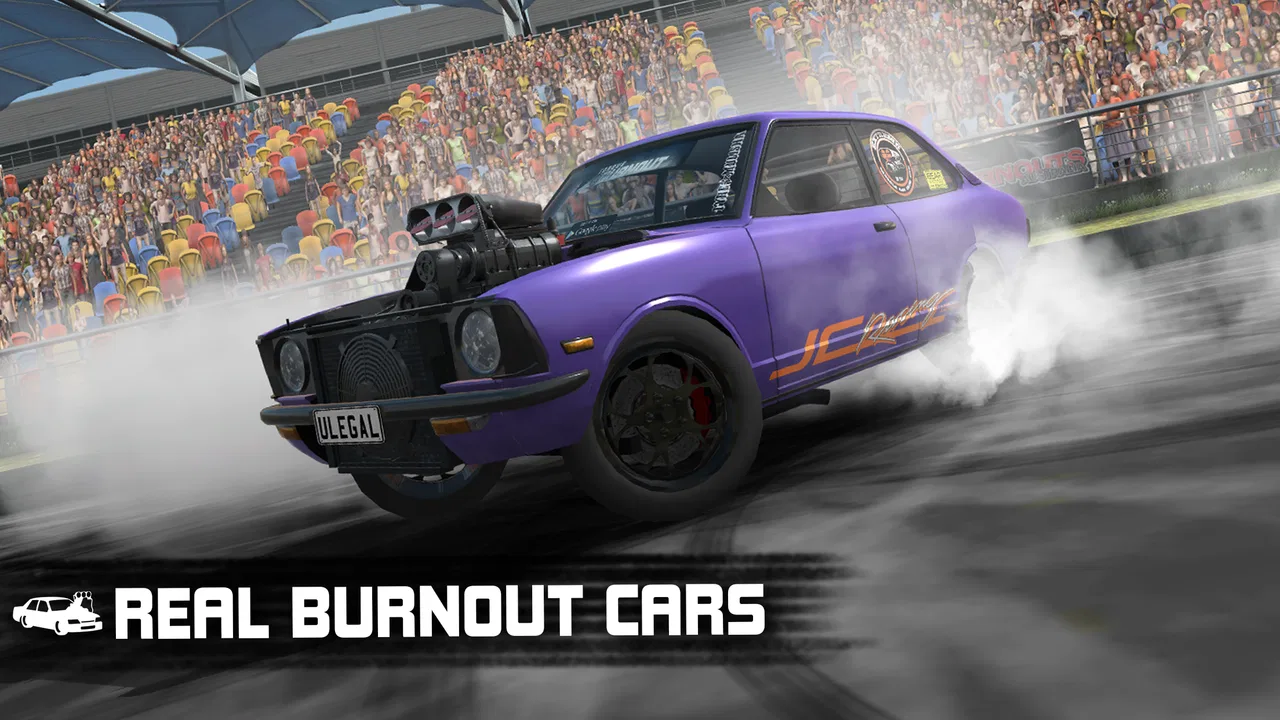
Torque Burnout is an arcade-style racing game focused on drifting, burnouts, doughnuts, and other car-control stunts rather than traditional lap racing. After trying it, the main appeal is its simple but satisfying driving model: you control throttle, steering, and braking while building score through stylish maneuvers. It is designed for short, action-packed sessions and offers a more relaxed experience than a serious racing simulator.
02Is Torque Burnout free to download and play?
Torque Burnout can generally be downloaded for free on supported mobile platforms, but the game may include optional in-app purchases. These purchases can provide extra currency, vehicles, upgrades, or other convenience features, depending on the current version. You can play without spending money, although progression may require more time if you choose not to purchase upgrades. It is also worth checking the store listing for current pricing and availability.
03Does Torque Burnout work offline?
Many of Torque Burnout’s core driving activities can be enjoyed without a constant internet connection, which makes it suitable for quick play while traveling or when mobile data is unavailable. However, certain features may depend on an internet connection, including advertisements, purchases, updates, cloud-related services, or online content. For the most reliable experience, launch the game online at least once and confirm which features remain accessible offline on your device.
04Is Torque Burnout suitable for beginners?
Torque Burnout is fairly accessible for newcomers because its controls are straightforward and the game encourages experimentation rather than demanding perfect racing lines. Nevertheless, controlling slides and maintaining a burnout can take practice, especially when you begin upgrading faster cars. The early events help you understand the basics, while repeated attempts gradually improve throttle control, steering timing, and score consistency. Players who enjoy learning through trial and error should find it welcoming.
05What devices are required to play Torque Burnout smoothly?
Torque Burnout is available for mobile devices, but performance can vary considerably depending on the phone or tablet’s processor, graphics hardware, available memory, and operating-system version. On newer devices, the game generally delivers better visual quality and smoother controls, while older hardware may experience reduced frame rates or longer loading times. Before downloading, check the official Google Play or App Store listing for the latest compatibility requirements and available storage information.
Pros
- Wide range of customizable cars and performance upgrades
- Responsive controls make drifting and burnouts satisfying
- Short events are ideal for quick gaming sessions
- Stylish visuals and detailed vehicle models
- Offline play is available for many game modes
Cons
- Frequent ads can interrupt the gameplay experience
- Some cars and upgrades require substantial grinding
- Touch controls may feel difficult for precise drifting
- Limited track variety can make races feel repetitive
- High graphics settings may drain battery quickly

Torque Burnout
Gallery